When Bonds No Longer Cushion

For decades the rule held: when equities fall, bonds cushion the decline. Since 2022 that rule can no longer be relied upon. Anyone who wants to spread risk in practice needs new diversification concepts.
A reliable partner becomes fickle
Since 2000, the rolling correlation between the S&P 500 and ten-year US Treasuries has mostly been in negative territory. With the rate shock of 2022, the pattern reversed. Since then it has been positive, at times above +0.5. When inflation concerns prevail, equities and bonds fall together. The offsetting effect is absent precisely when it would be needed.
2022 exposed a weakness that is easily overlooked. A portfolio can appear well diversified across equities, bonds, currencies and commodities. Backtests from years of negative correlation may credit it with shallow drawdowns. If a portfolio is structurally long in all of these markets, however, a single macroeconomic shock can hit all positions at once. What is then spread is only the asset classes, not the direction of the risk.
A new dimension of diversification
Trend-following strategies are not new, but they start exactly here. They do not predict the next macro regime. They follow the direction of observed price movements according to fixed rules. The same market can thus be held long or short.
For government bonds this means: if a rise in yields turns into a sustained fall in prices, a long/short strategy goes short in bond futures. What weighs on the classical bond allocation becomes a potential source of return.
A practical test over recent months
How quickly return sources change is shown, for example, by Everon’s Multi-Asset Directional strategy, which trades futures on equity indices, government bonds, currencies and commodities. In April and May, equities carried the strategy. In June, trends in industrial and precious metals reversed abruptly, and the month closed around 4 percent down. Government bonds and energy then took over.
The principle became clearest in September. Rising energy prices increased inflation concerns and pushed bond yields up. Short positions in bonds contributed just over 3 percentage points, shorts in the euro and long positions in energy were added, and equities cost performance. In a month in which equities and bonds declined together, most of the return came from the short side. Strategy returns can arise precisely when a classical portfolio is under pressure.
Simulating a 25 percent blend for a 60/40 portfolio since 2016, the annualised return rises from 5.0 to 5.3 percent, and the volatility of annual returns falls from 9.8 to 7.2 percent. In 2022 the portfolio would have lost 5.1 instead of 16.2 percent. In 2023, by contrast, it would have returned only 0.1 instead of 7.5 percent.
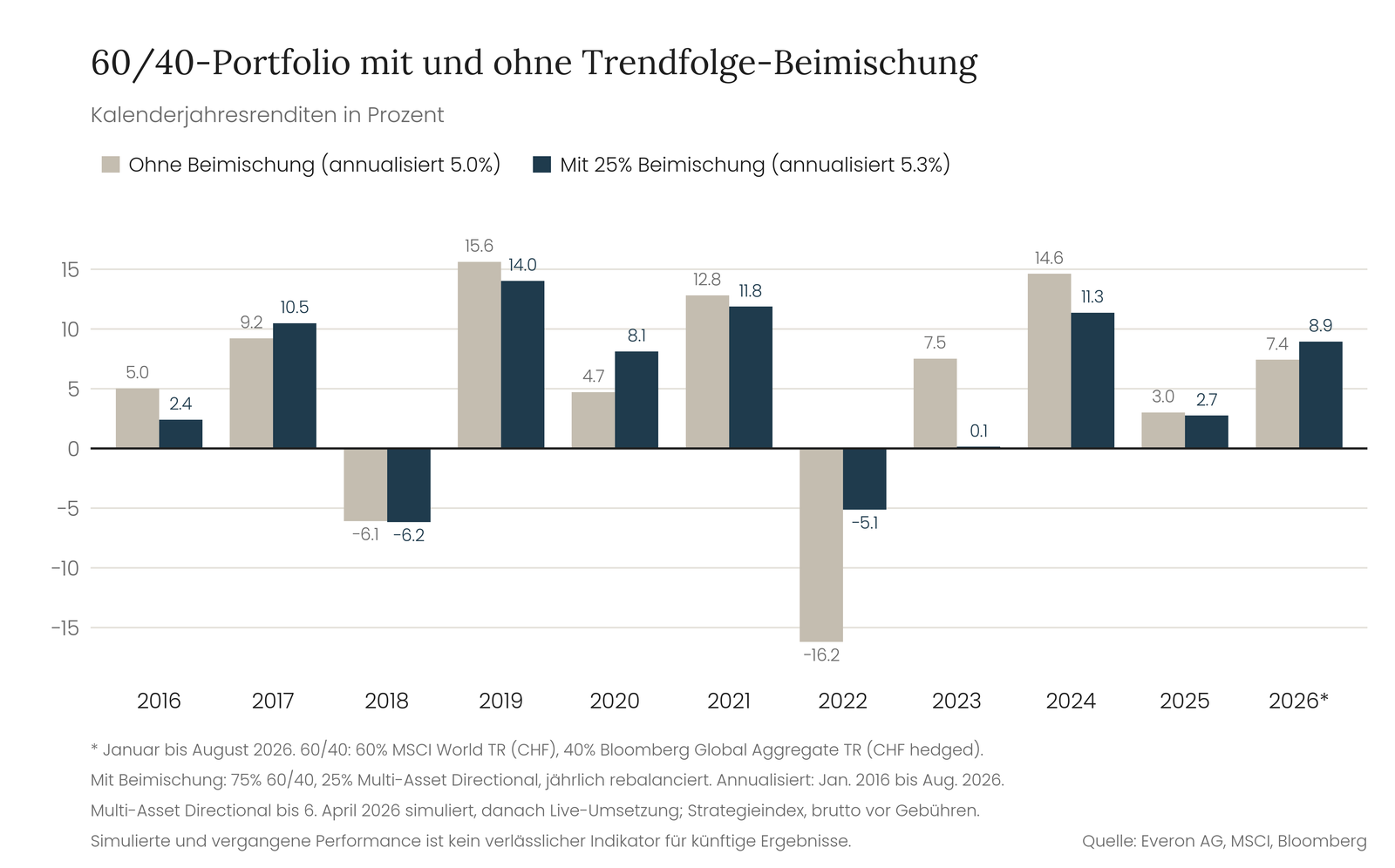 Chart (labelled in German): 60/40 portfolio with and without a trend-following blend, calendar-year returns in percent, January 2016 to August 2026. 60/40 stands for 60 percent MSCI World TR (CHF) and 40 percent Bloomberg Global Aggregate TR (CHF hedged); with the blend, for 75 percent of that and 25 percent Multi-Asset Directional, rebalanced annually. Multi-Asset Directional is simulated up to 6 April 2026 and implemented live thereafter; strategy index, gross of fees. Simulated and past performance is not a reliable indicator of future results. Source: Everon AG, MSCI, Bloomberg.
No insurance
Trend-following strategies do not, however, protect against every market decline. Unlike a hedge with put options, they offer no downside protection defined in advance, but nor do they require ongoing option premiums. The isolated option component of the Cboe S&P 500 5% Put Protection Index delivered an annualised return of around -2.6 percent from January 2001 to January 2026.
The risk profile of trend following is a different one. It can benefit from sustained directional moves across several markets, but it is vulnerable to abrupt trend reversals. June showed this.
Complement, not replacement
Trend-following strategies are meant to complement traditional allocations, not replace them. Because their positions can change direction across different markets, they bring return sources into the portfolio that do not depend structurally on rising equity or bond prices. Implementation, however, requires access to liquid derivatives, systematic risk management and efficient execution.

This article is for general information purposes only and does not constitute investment, legal or tax advice, nor an offer to buy or sell financial instruments. Everon AG is a wealth manager licensed by FINMA under FinIA. Past performance is not a reliable indicator of future returns.
The Everon strategy performance shown is historical and is stated before costs and fees.