
Market Update September 2026

The Federal Reserve raised rates on 16 September for the first time since 2023, the opening move under Chair Kevin Warsh. How the oil shock, a 10-year Treasury yield at 5.29% and fresh records on the Nasdaq fit together.
September brought the first US rate hike since 2023. On 16 September the Federal Reserve lifted its target range by 25 basis points to 3.75% to 4.00%, a unanimous decision and the first move under Chair Kevin Warsh. The ECB had raised rates six days earlier, while the SNB left its policy rate at 0%. Energy explains most of it. The war between the United States and Iran flared up again, a drone attack shut Saudi Arabia’s East-West pipeline, and Brent gained about 14% over the month. Bonds took the strain: the 10-year Treasury yield ended September at 5.29%, a level last seen in 2002. Equities held up better than that backdrop might suggest. The Nasdaq set new records on the strength of chip and AI stocks, while the Dow, the main European indices and the SMI all lost ground. The franc weakened against the dollar and the euro, and gold had its worst month since June.
Geopolitical Developments
The US-Iran conflict set the tone again. With the ceasefire broken since July, the Strait of Hormuz stayed contested throughout the month. On 8 and 9 September US forces struck and disabled five Iranian tankers, at least one of which sank, and Tehran said it had hit ten ships near the strait. Brent moved above $100 a barrel. On 11 September, after drone attacks launched from Iraq, Saudi Arabia shut its East-West pipeline, which had been carrying four to five million barrels a day to the Red Sea.
In the last week of September, Qatar brokered talks between Washington and Tehran on the sidelines of the UN General Assembly in New York. Iran offered to reopen Hormuz within seven days in return for an end to the US blockade, sanctions relief and access to about $12 billion in frozen assets. President Trump rejected the offer. The pipeline restarted on 22 September and loadings at the Red Sea port of Yanbu resumed in the final week, which eased physical supply somewhat.
US envoys Steve Witkoff and Jared Kushner met Vladimir Putin and then Volodymyr Zelensky in early September, but talks on Ukraine produced no ceasefire. Relations between Washington and Beijing improved: at a summit in Washington in the last week of September, Presidents Trump and Xi agreed to cut tariffs on about $30 billion of goods and to open a dialogue on artificial intelligence. A stopgap budget signed on 2 September funds the US government until 11 December, which removed the usual end-of-September shutdown risk.
Market Developments by Asset Class
Equities
The S&P 500 slipped about 0.5% to 7,652 in September and the Dow lost 4.3%, while the Nasdaq Composite gained 1.9% to 26,861 and posted fresh records along the way. Technology was the only S&P 500 sector to finish higher, up 5.1%, with semiconductor stocks gaining more than 9%. Breadth was thin. On 21 September, as the Nasdaq hit a record, 30 S&P 500 members set 52-week lows and only seven set highs. Small caps took the brunt, and the Russell 2000 lost 5.4%.
The STOXX 600 fell about 2.5%, Europe’s first monthly loss in six months. The Euro Stoxx 50 lost 2.4% to 6,269 and the DAX dropped roughly 4% to 25,199. Higher yields, the oil shock and the ECB hike weighed across the region, and French government bonds came under pressure over the country’s fiscal path.
The SMI lost about 2.5% and closed at 13,830. Two stock stories shaped the Swiss month. Novartis reported failed late-stage trials twice within a week, pelacarsen on 4 September and del-desiran on 8 September. The second announcement sent the shares down 10.9% in one session to CHF 111.80, only days after a record high of CHF 132.68. Julius Baer went the other way. On 29 September FINMA closed its enforcement proceedings over the Signa loans and anti-money-laundering failings. It confiscated about CHF 10 million in profits from two Russian client relationships and halved the bank’s additional capital requirement to CHF 250 million. The shares closed more than 7% higher on the day. UBS fell 8.8% over the month after the Council of States voted on 23 September to require 90% core-capital backing for its foreign subsidiaries. Partners Group lost 17.5% after a CEO change and a warning on performance fees, while Sandoz led the index with a 6.5% gain.
Bonds
The 10-year Treasury yield rose 54 basis points to 5.29%, and the 2-year climbed by the same amount to 4.88%. Oil-driven inflation did most of the damage: August CPI came in at 3.4% year on year, with energy prices up more than 16%. The Fed’s new projections put the median policy rate at 4.1% for the end of 2026, implying one more hike this year, and raise growth forecasts to 2.3% for 2026 and 2.4% for 2027. The labour market is cooling at the same time. September payrolls, published on 2 October, showed only 29,000 new jobs, and unemployment edged up to 4.2%.
The ECB raised its three key rates by 25 basis points on 10 September. The deposit rate now stands at 2.50% and the main refinancing rate at 2.65%. The flash estimate for September, released on 2 October, showed euro area inflation at 3.8%, up from 3.2% in August and above expectations, with energy prices 18.8% higher than a year ago. The 10-year Bund yield rose about 30 basis points to 3.57%.
The SNB kept its policy rate at 0% on 24 September. Chairman Martin Schlegel noted that the franc had lost about 3% on a trade-weighted basis since June as interest-rate differentials widened, and the SNB repeated that it is willing to be active in the foreign exchange market as necessary. Its conditional inflation forecast stands at 0.7% for 2026 and 0.8% for 2027 and 2028. Swiss inflation rose to 1.0% in September, according to figures published on 1 October. The 10-year Confederation yield climbed 18 basis points to 0.58%, after touching about 0.65% in the week of 21 September.
Real Estate (Switzerland)
Ten-year fixed mortgages in Switzerland rose above 2% for the first time in a long while, reaching 2.06% on 21 September, while five-year money cost 1.83%. The mortgage reference rate stayed at 1.25% at its 1 September publication, with the underlying average rate at 1.31%. Listed property funds gave back ground: the SWIIT index stood 2.28% lower for the year on 24 September, while Swiss real estate shares were about 3% higher over the same period.
Fundamentals remain firm. The national vacancy rate has fallen to 0.93%, the first reading below 1% in about 15 years, and asking rents were 1.2% higher year on year in the second quarter. We do not expect the reference rate to rise before summer 2027. Scarce supply and steady rents continue to support residential property, although funds trading at high premiums are the most exposed if yields keep rising.
Commodities
Oil was again the swing factor. Brent gained about 14% in September, its largest monthly rise since July, and the expiring front-month contract settled at about $103.50 a barrel. WTI rose about 5% to roughly $90.
Dutch TTF gas prices averaged EUR 61.6 per megawatt hour in September, up from EUR 53.3 in August, with storage levels still low heading into winter. Copper held up comparatively well: LME cash copper ended the month at about $14,487 a tonne, almost unchanged, after touching $14,797 on 22 September. A return to expansion in China’s manufacturing PMI helped.
Gold fell more than 6% to around $4,150 an ounce, its worst month since June, as rising real yields and a firmer dollar reduced the appeal of non-yielding assets. Silver lost about 8% to roughly $61.
Everon Strategies and Portfolio Positioning
Income Strategies
Income 100 CH, our Swiss equity income strategy, returned -2.26% in September against -2.75% for its benchmark, the iShares Swiss Dividend ETF (CH), an outperformance of 0.49 points. Stock selection did the work, adding 0.50 points, while sector allocation was neutral at -0.01. Industrials contributed most. Our industrial holdings lost only 0.6%, against 5.0% for those in the benchmark, as VAT Group (+13.6%), SGS (+2.8%) and ABB, none of which the benchmark holds, rose while Holcim fell 6.2%; we hold Holcim at 2.3%, against 9.4% in the benchmark. Emmi (+1.7%) added in consumer staples. Financials were the weak spot, where UBS, which is not part of the benchmark, fell 9% and cost 0.27 points. Income 60 CH lost 2.24%, and Income 60 Global lost 1.82% as its US dividend payers spread the risk.
Julius Baer is not in the benchmark either, so our 4.2% holding is a fully active position. The rally after the FINMA decision on 29 September added about 0.3 points to the portfolio in a single session, and over the month the position added 0.07 points against the benchmark, although the shares ended September 1.2% lower. Novartis sits at 8.7%, against 14.5% in the benchmark. When the shares fell 10.9% on 8 September, that underweight saved about 0.6 points relative to the benchmark on the day; the advantage faded as the stock recovered, and the effect over the month was close to zero. Holding less Zurich Insurance than the benchmark also paid off, while the smaller Swiss Re position and VZ Holding (-10.2%) held us back. The portfolio offers a dividend yield of 3.3%, and its 15 largest holdings make up 82% of the portfolio, against 98% for the benchmark.
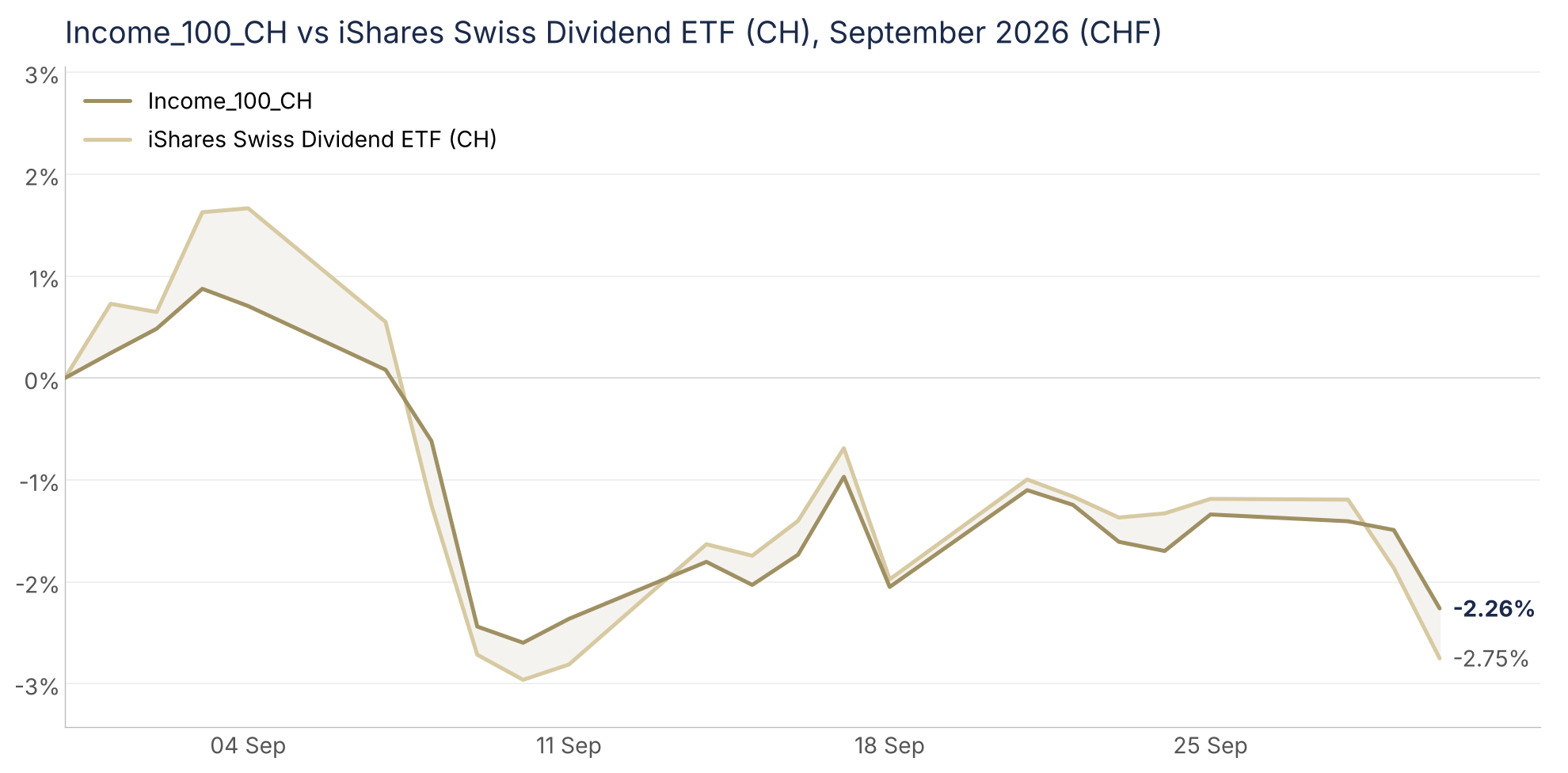 Chart 1: Income 100 CH against the iShares Swiss Dividend ETF (CH), cumulative performance over September 2026. Source: Everon AG, own calculation; market data: Refinitiv.
Multi-Factor Strategies
Multi-Factor 60 Global lost only 0.68% in September, the smallest decline among our strategies, as its technology holdings gained 9.6% in francs. Its North American equity component, MultiFactor NorthAmerica Equities, gained 0.28% in US dollars while its benchmark, the SPDR S&P 500 ETF Trust, fell 0.35%. Selection added 0.44 points and allocation 0.19. Technology picks drove the result: our technology stocks rose 7.0%, against 5.2% for the sector in the benchmark, with AMD (+30%), KLA (+11%) and Arista Networks (+4%) standing out, and the building contractors Comfort Systems and EMCOR added as well. Having no utilities, real estate or materials stocks helped, as each of those sectors fell around 6%. Casey’s General Stores (-22%) was the costly holding, followed by Old Dominion Freight Line (-13%).
The European component, MultiFactor EU Equities, returned -3.00% in euros. ASML (+10%) was its largest contributor, followed by Shell (+7%) as oil rallied, and industrial picks held up well: AQ Group rose 7.3%, Diploma 5.6% and Legrand 3.7%. Financials, down 8.1%, weighed on the result, with the online brokers flatexDEGIRO (-22%) and Plus500 (-8%) the largest drags. The gold fund in Multi-Factor 60 Global cost 0.48 points as the metal fell. Multi-Factor 60 Global holds roughly 80% in equities, 12% in bonds and 5% in cash, spread across 100 positions.
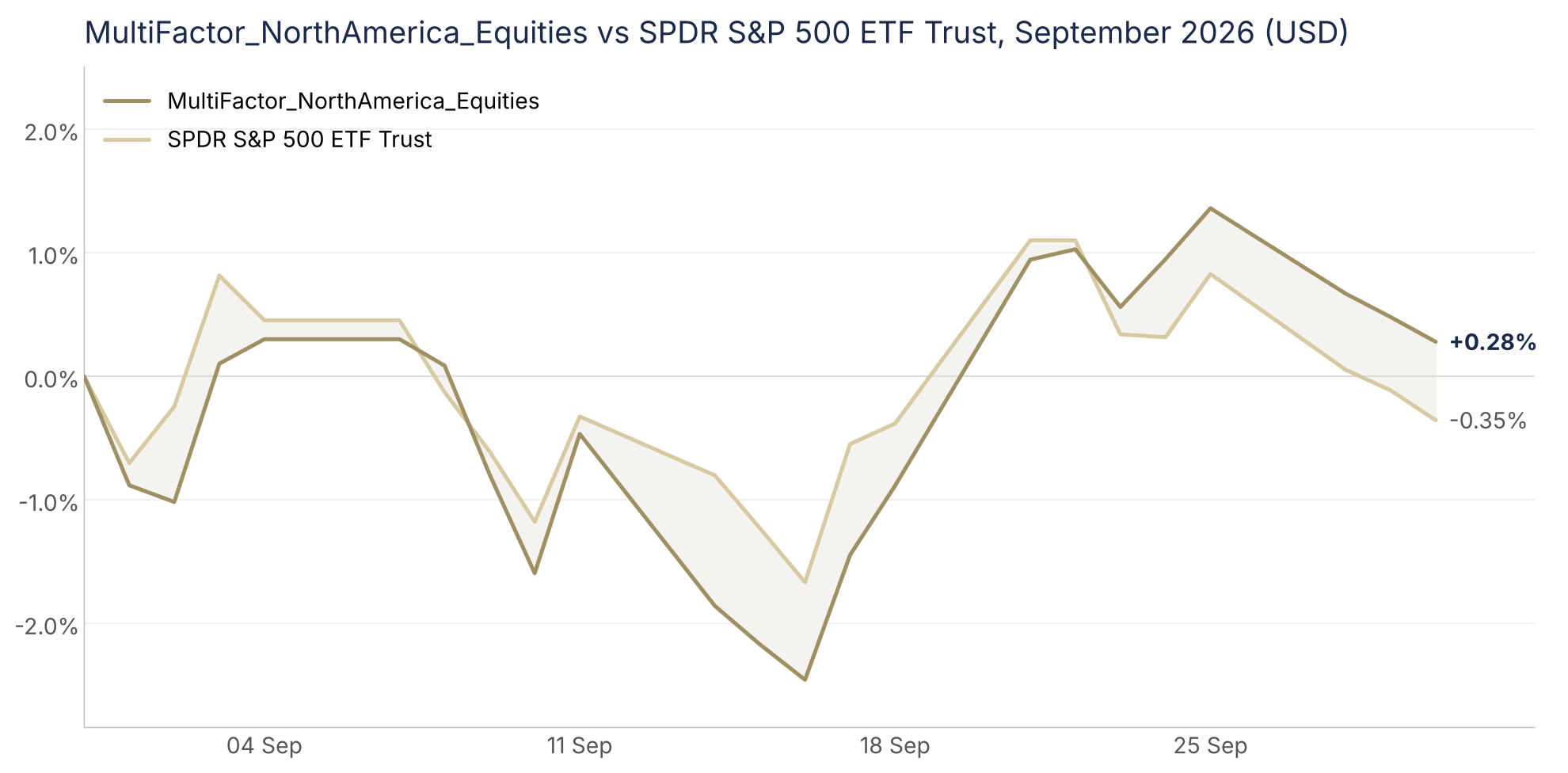 Chart 2: MultiFactor NorthAmerica Equities against the SPDR S&P 500 ETF Trust, cumulative performance over September 2026. Source: Everon AG, own calculation; market data: Refinitiv.
Outlook
October brings a busy calendar. The Fed meets on 27 and 28 October with its projections pointing to one more hike this year, and the ECB decides on 29 October after an upside surprise in September inflation. The SNB’s next assessment follows on 10 December. Third-quarter earnings season starts in mid-October, with consensus expecting S&P 500 earnings growth of around 29% year on year. That is a high bar for a market trading near its records.
Energy remains the main risk. A deal that reopens the Strait of Hormuz would bring oil and inflation expectations down quickly and take pressure off bond yields. Without one, central banks may have to tighten further into a labour market that is already slowing. The US midterm elections on 3 November add a political variable.
For Swiss investors the franc deserves attention. USD/CHF rose about 3% in September to roughly 0.835, and EUR/CHF ended the month at 0.948, as the Fed and ECB hikes widened the rate gap. We expect the franc to regain strength over the coming quarters as the rate gap narrows again. For investors and companies with future US dollar income, current levels look attractive for hedging part of that exposure. Our portfolios remain diversified across regions and factors, with a quality bias and disciplined position sizing.
Your Everon Investment Team

This article is for general information purposes only and does not constitute investment, legal or tax advice, nor an offer to buy or sell financial instruments. Everon AG is a wealth manager licensed by FINMA under FinIA. Past performance is not a reliable indicator of future returns.
The Everon strategy performance shown is historical and is stated before costs and fees.