From Football Models to Financial Markets
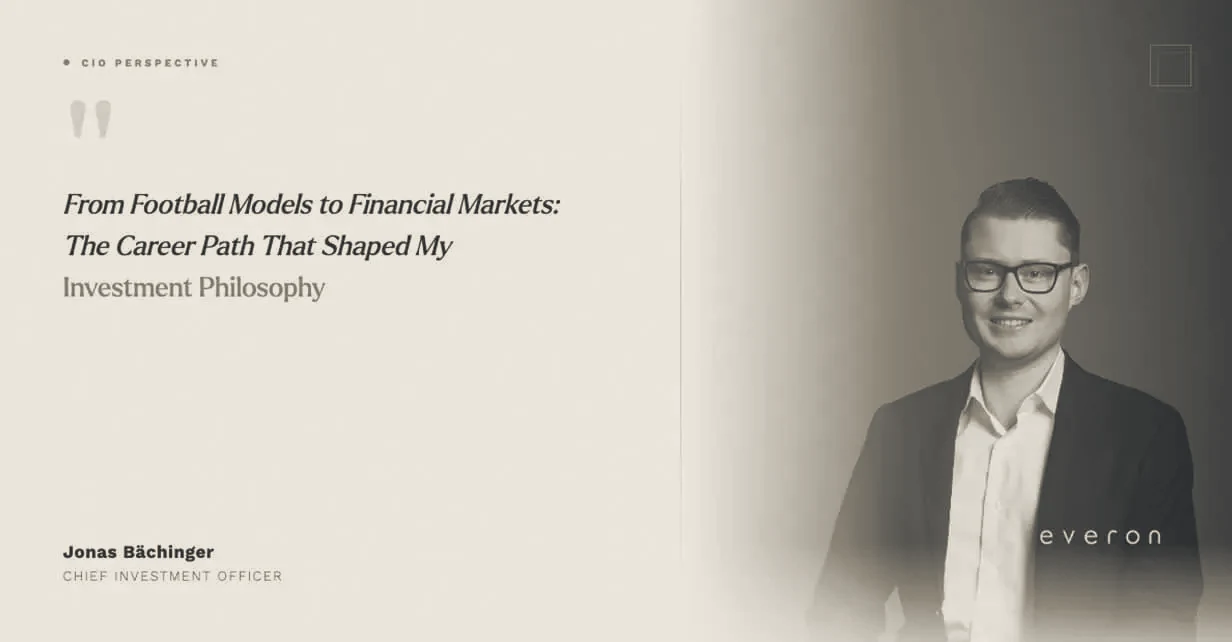
Long before working in financial markets, Everon's co-founder and CIO built probabilistic models to forecast football outcomes. How that early quantitative thinking still shapes portfolio strategy today.
Careers in investment management are rarely linear. Looking back, however, the underlying theme in mine has been consistent: understanding uncertainty and structuring it intelligently.
Long before I worked in financial markets, I was drawn to quantitative thinking. Mathematics was never just an academic interest. It was a way of interpreting complexity. During my early years, that curiosity extended even into sports analytics, where I built probabilistic models to forecast football match outcomes and tournament dynamics. What mattered was not predicting single events, but understanding distributions over time.
That mindset ultimately shaped how I approach financial markets.
Academic Foundations: Risk, Probability and Structure
I pursued mathematics with a clear focus on probability theory, stochastic processes and statistics. What appealed to me most was the application of theory to real systems. Markets, unlike textbooks, are adaptive, behavioral and sometimes irrational. Yet even within that complexity, probabilistic structures exist.
During my graduate studies, I specialised in mathematical finance and financial systems. Topics such as fat-tailed distributions, regime shifts, crisis dynamics and long-term return expectations became central to my thinking. One fundamental insight has remained consistent throughout my career: short-term market outcomes are uncertain, often highly volatile. Over longer horizons, however, statistical tendencies become significantly more stable.
Understanding that distinction is essential. Investment strategy is not about forecasting next quarter’s market move. It is about constructing portfolios that are robust across a wide range of potential futures.
Professional Experience: From Markets to Risk Leadership
My early professional years were spent in investment banking and foreign exchange spot trading. These environments demand precision, speed and discipline. They also provide immediate feedback. Decisions have consequences in real time.
I later moved into a family office environment, focusing on risk management. That shift was formative. It required stepping back from individual trades and thinking holistically about capital preservation, drawdowns, liquidity and stress scenarios. Managing wealth across cycles forces a longer-term perspective and a deeper appreciation of downside risk.
Once real capital are involved, finance becomes more than modelling. Behavioral dynamics become visible. Market volatility is not an abstract concept. It affects confidence, planning and long-term objectives. Integrating quantitative rigour with an understanding of human behavior is a defining aspect of effective portfolio management.
Building and Leading Investment Strategy at Everon
As co-founder and CIO of Everon, my responsibility is to oversee the investment architecture, risk framework and continuous development of our strategies.
It is encouraging that our strategies consistently rank among the best in Switzerland according to BILANZ. Recognition is appreciated, but it is not the objective. The true objective is structural robustness. Portfolios must withstand different market regimes, not just perform well in favourable environments.
Our philosophy is clear:
-Decisions must be evidence-based.
-Risk must be understood in depth, not superficially measured.
-Emotional bias must be actively managed.
-Quantitative analysis does not replace judgment, but it disciplines it. Gut feeling alone has no place in strategic asset allocation.
The Daily Reality of a CIO
There is no perfectly typical day, but there is a structured rhythm.
Systematic Oversight and Rebalancing
On a monthly basis, we conduct comprehensive rebalancing across our investment universe. This process is data-driven and systematic. We review performance drivers, volatility patterns, correlation structures, valuation indicators and macroeconomic developments.
The purpose is not to trade frequently. It is to ensure that portfolios remain aligned with their intended risk-return characteristics.
A meaningful portion of my time is dedicated to analysing data and reviewing model outputs. Equally important, however, is the interpretation of that analysis and the translation into strategic decisions.
Strategy Development in a Changing Market Environment
Markets evolve. Concentration risks emerge. Correlations shift under stress.
In recent years, the dominance of US mega-cap technology stocks has altered global index structures and risk exposures. Such developments require strategic reflection. Are portfolios inadvertently exposed to narrow risk factors? How resilient are they if leadership rotates? How do diversification benefits behave in crisis scenarios?
Improving strategy design is an ongoing responsibility. Some refinements are incremental. Others require structural reassessment when regimes change.
Designing for Real Client Objectives
Many of our clients prioritise stability and capital preservation over aggressive benchmark outperformance. Their objective is steady compounding with controlled drawdowns.
Constructing portfolios for that objective requires careful optimisation of correlation structures, diversification across independent return drivers and rigorous stress testing under extreme conditions.
A critical aspect of the CIO role is communication. Sophisticated quantitative frameworks must be explained clearly. Clients do not require technical detail. They require clarity, transparency and confidence in the underlying logic.
Balancing Short-Term Dynamics with Long-Term Discipline
One of the most demanding aspects of the role is distinguishing between temporary market noise and structural change.
Daily volatility is expected. Structural regime shifts are less frequent but more consequential. Inflation cycles, monetary policy transitions or geopolitical realignments may require strategic adaptation.
The discipline lies in not overreacting to short-term fluctuations while remaining sufficiently flexible to adjust when the underlying regime genuinely changes.
Long-term strategy should be stable, but never rigid.
A Responsibility, Not Just a Role
At its core, the role of a CIO combines three dimensions:
-Quantitative structure to model uncertainty.
-Risk management to protect capital.
-Behavioral awareness to guide clients through volatility.
Managing capital is a responsibility that extends beyond performance metrics. It involves safeguarding trust, preserving wealth across cycles and maintaining discipline in uncertain environments.
The intellectual curiosity that once drove me to explore probability models remains central to my work today. The context is different, but the core principle is unchanged: uncertainty can be structured, risk can be managed, and disciplined strategy compounds over time.
This article is for general information purposes only and does not constitute investment, legal or tax advice, nor an offer to buy or sell financial instruments. Everon AG is a wealth manager licensed by FINMA under FinIA. Past performance is not a reliable indicator of future returns.